Omnichair
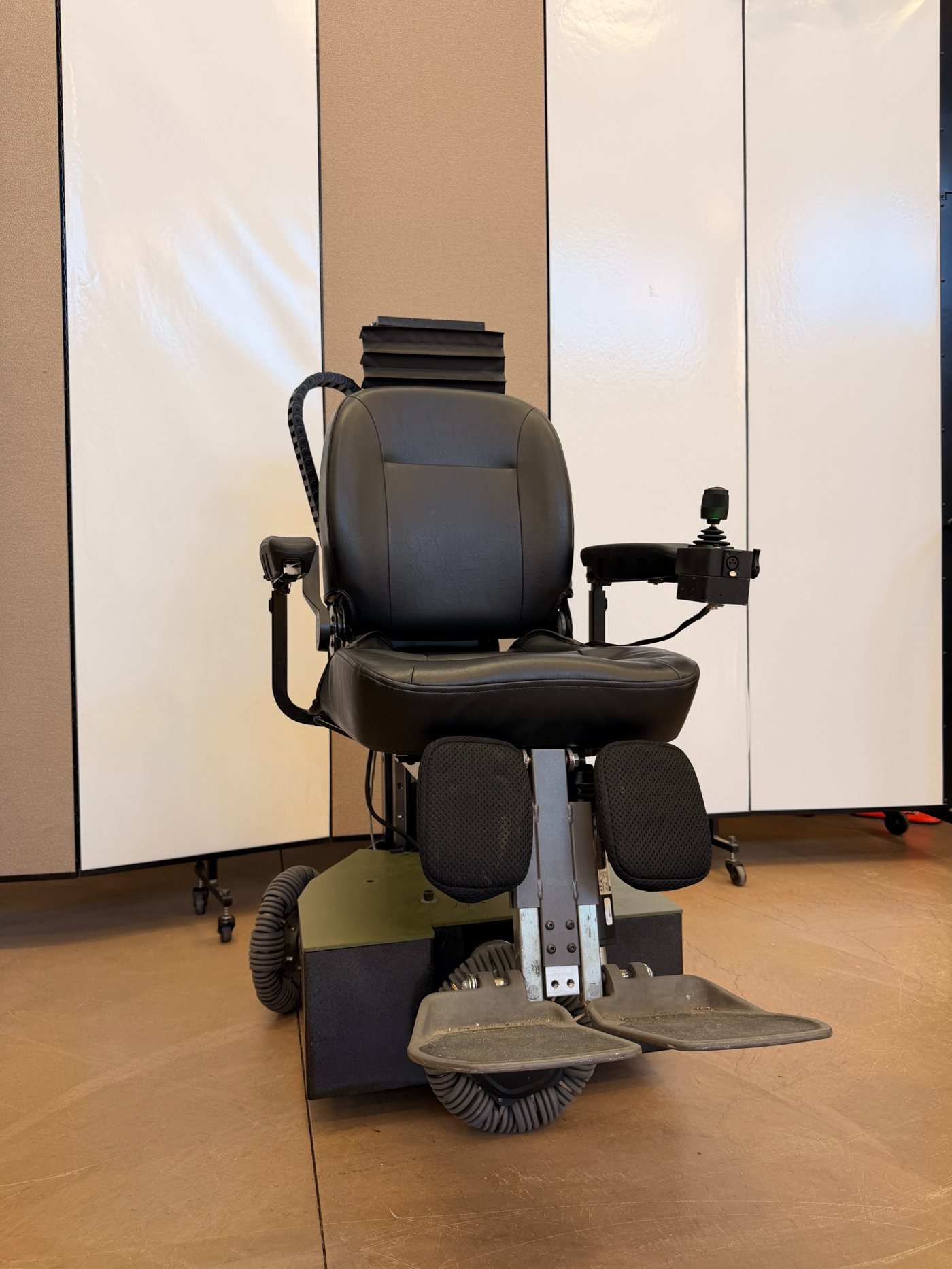
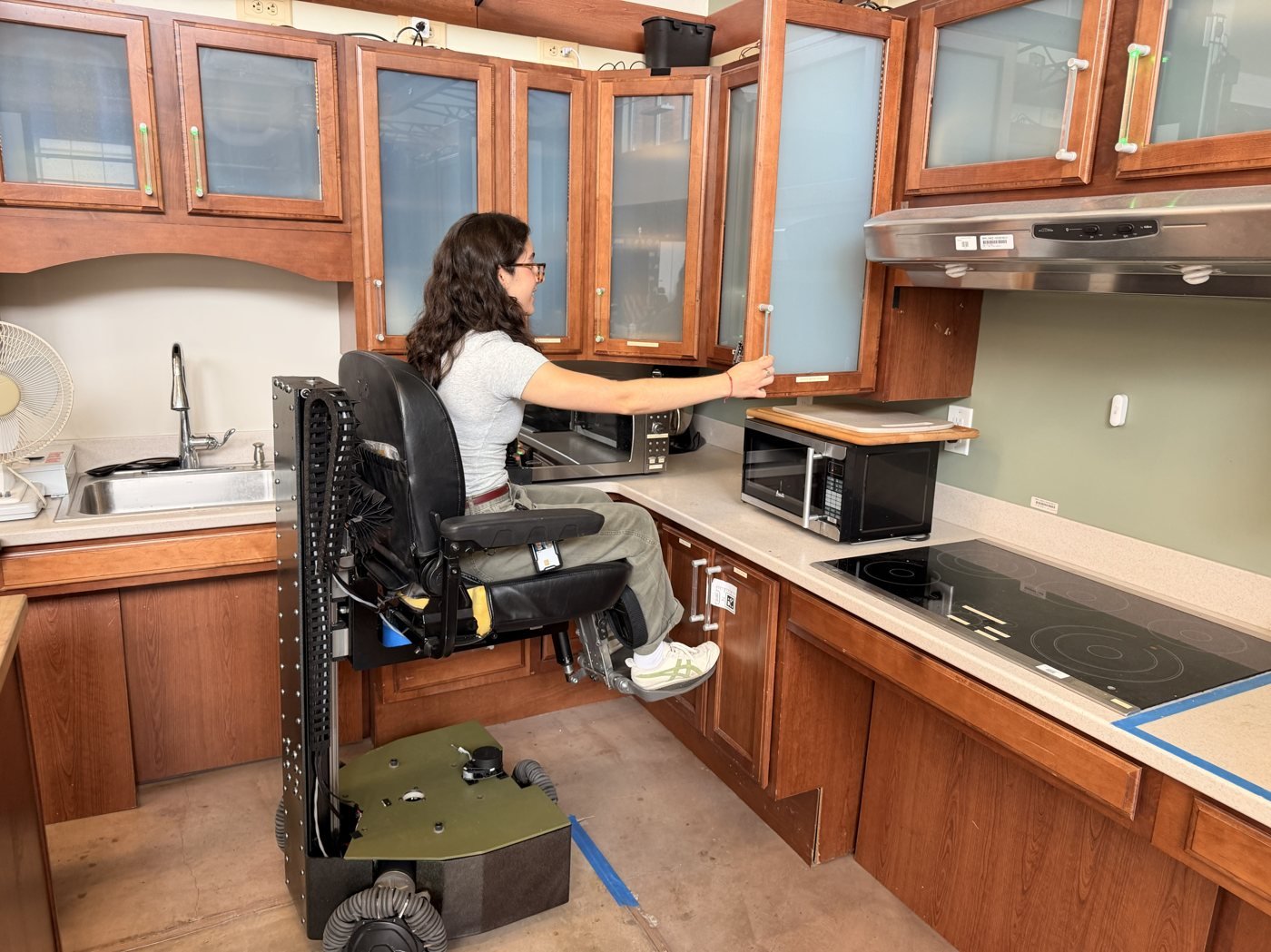
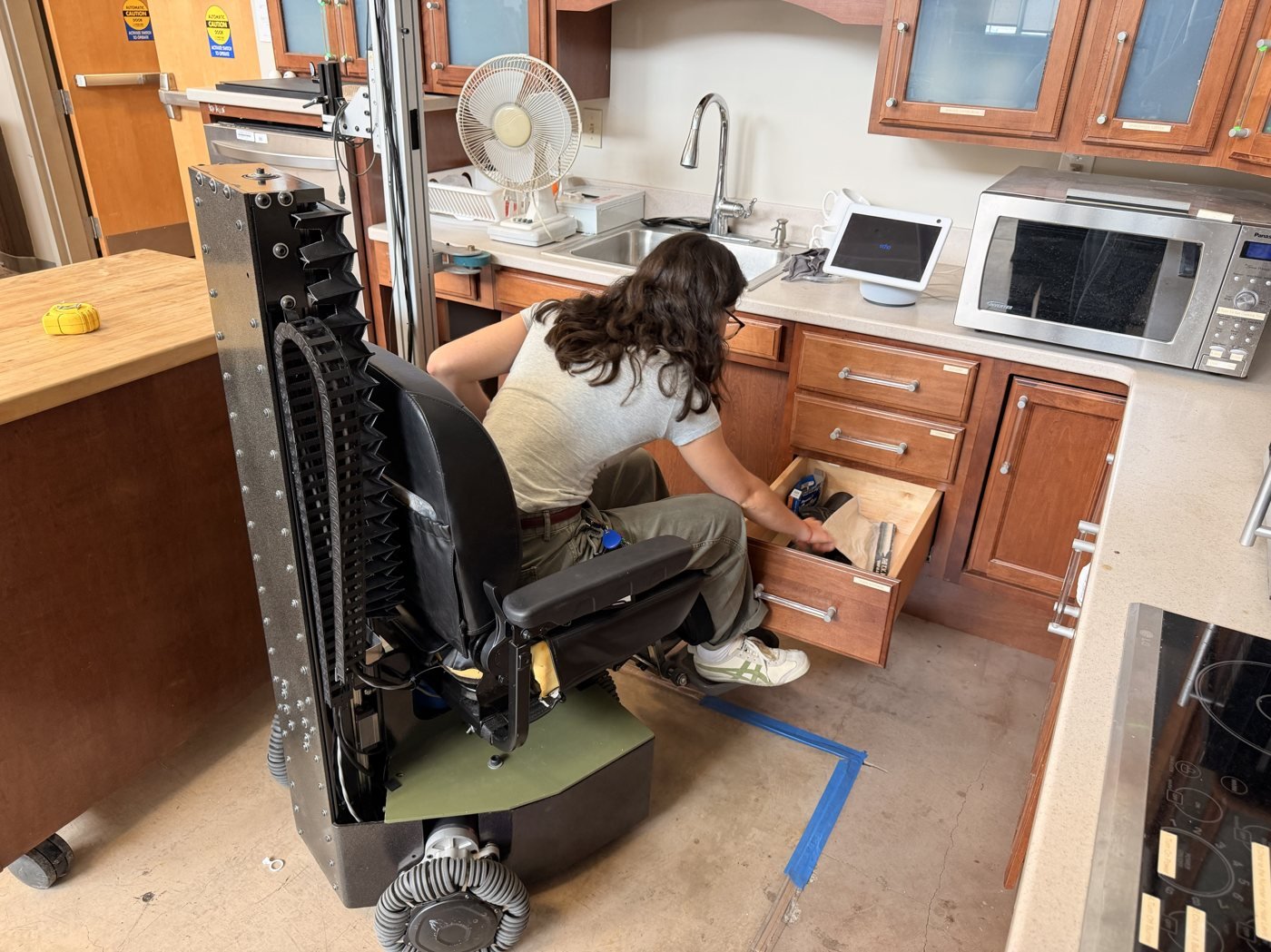
An omnidirectional wheelchair for improved mobility and reach. It moves in any direction without turning and raises its seat 36 inches, from a floor drawer to an upper cabinet.
Skills
- Embedded Firmware
- PCB Design
- Control Systems
- Robot Kinematics
- Data Logging & Analysis
- Bench Testing
- Research
Tools
- Teensy
- RoboClaw Motor Controllers
- ESP32
- IMU
- C / C++ (Arduino)
- MATLAB
- KiCad
About the Project
Roughly 3.3 million Americans use wheelchairs, with millions more relying on scooters and other mobility aids. A standard wheelchair moves only forward, backward, and turns. Sideways motion isn't possible, and the seat height is fixed. Those limits show up in daily life, like reaching a top shelf or navigating a tight space, and in vocational settings like STEM labs, workstations, wet labs, and offices.
The Omnichair is a research wheelchair I work on at the Human Engineering Research Laboratories, a joint program of the VA Pittsburgh Healthcare System and the University of Pittsburgh. It removes two of those limits. It moves in any direction without turning, and its seat raises 36 inches, from a floor drawer to an upper cabinet, so a user can approach almost any workstation and reach almost any surface without repositioning the chair.
What I Worked On
I'm the student researcher on the software and testing side of the project, working under the lab's principal investigator, and first author on the 2026 research poster. My work focused on four things:
- Driving control: retuning the open-loop control so the chair drives accurately in every direction.
- Autonomous path testing: validating driving accuracy across three canonical paths: a square, a circle, and a slalom.
- Sensing: adding an IMU to measure the chair's heading and motion while driving.
- Wireless datalogging: adding an ESP32 to stream encoder counts and IMU data off the chair in real time.
- PCB design: designing custom multi-board PCBs in KiCad that integrate the chair's microcontrollers, motor controllers, IMU, and power distribution.
How It Works
Three motorized wheels sit in a triangle around the base. Rolling them at coordinated speeds lets the chair move in any direction (forward, backward, sideways, or diagonally) and rotate independently, keeping the seat pointed wherever the user chooses. A powered lift raises the seat over a 36-inch range, and a powered footrest adjusts underneath.
Two microcontrollers share the work. An Interface board reads the joystick and converts it into three wheel speeds using a kinematic model. A Base board runs the wheels through their motor drivers, handles the brakes and seat elevation, and logs the sensor data. It can also drive preset paths on its own, without the joystick, for testing.
Mobility Comparison
To show what the added mobility actually buys, we compared everyday reaching and repositioning against a standard power wheelchair. The Omnichair traverses from the refrigerator to the stove with a single lateral movement and no turning, where a standard power wheelchair has to reposition repeatedly to cover the same path.
Omnichair
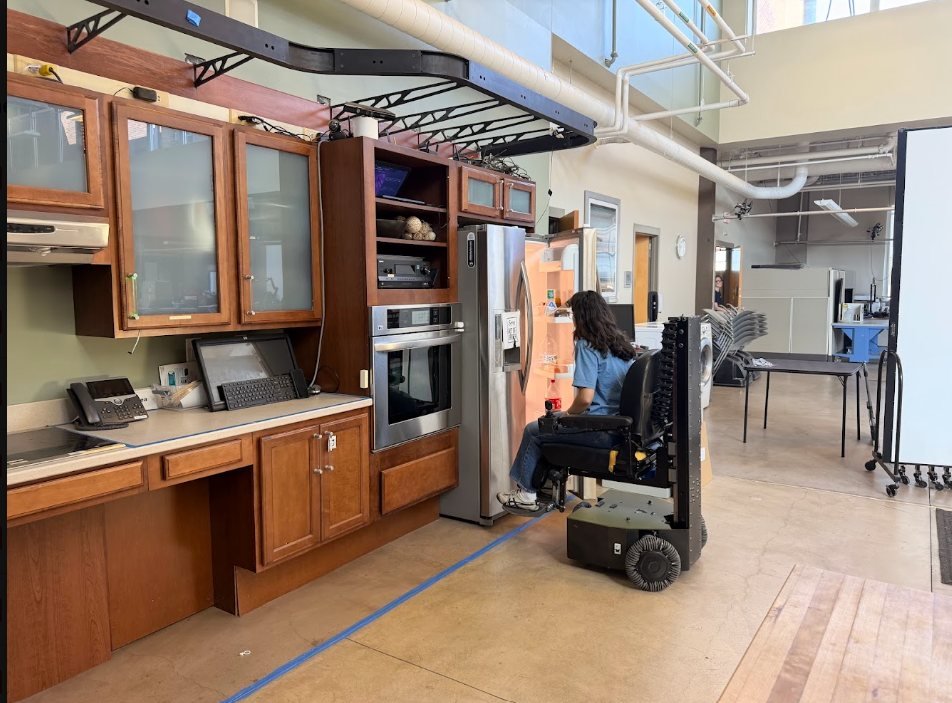
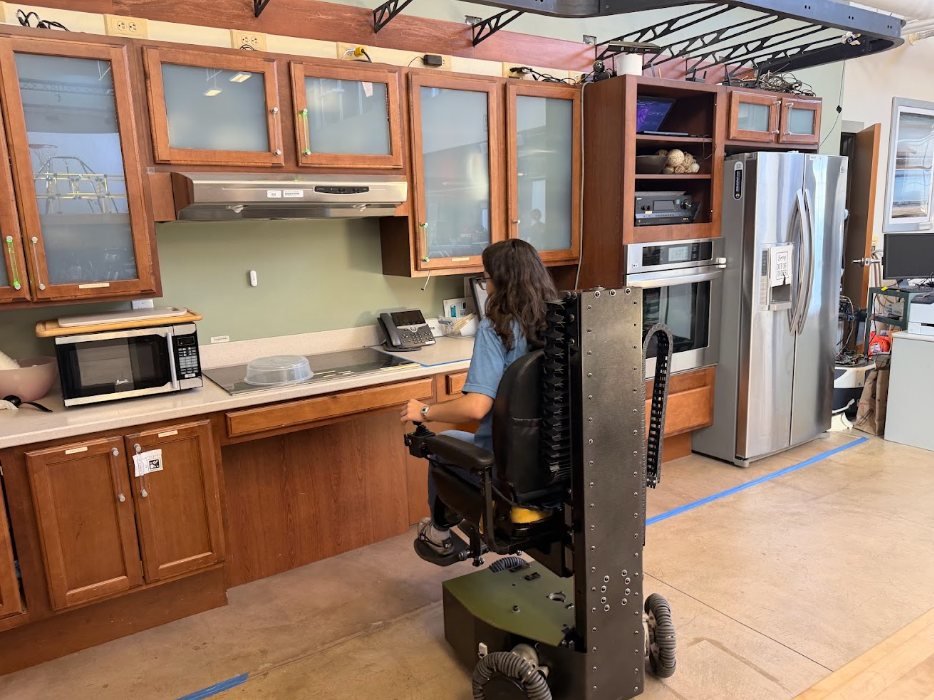
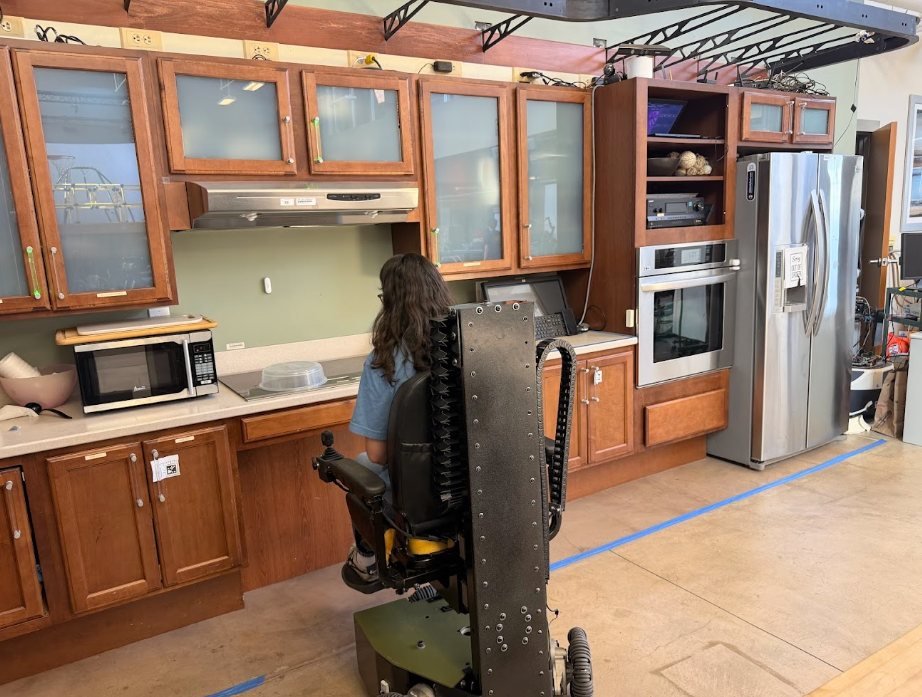
Omnichair traversing from refrigerator to stove with one lateral movement.
Standard power wheelchair
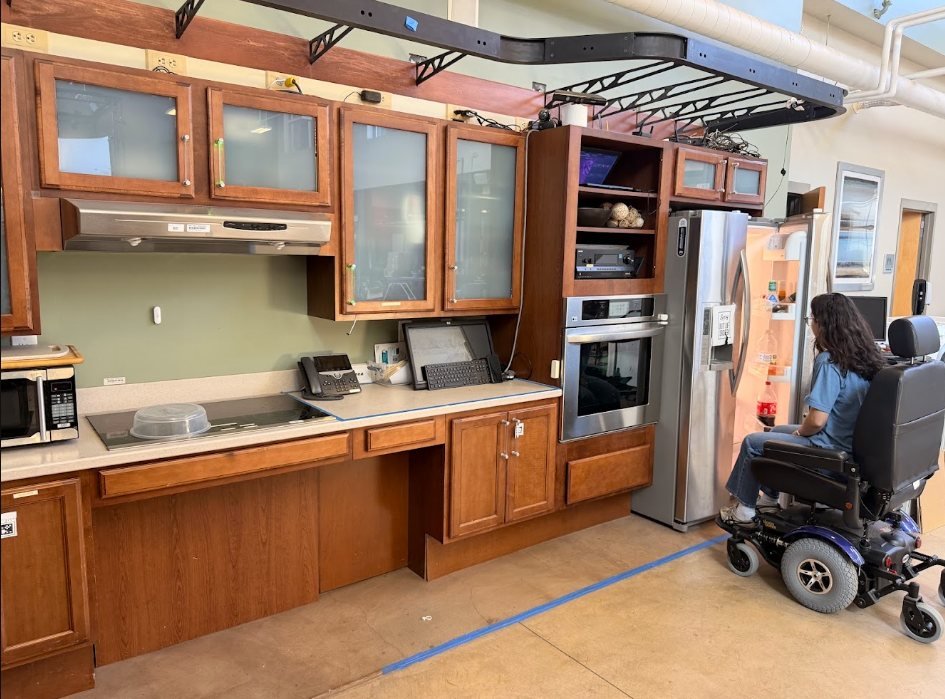
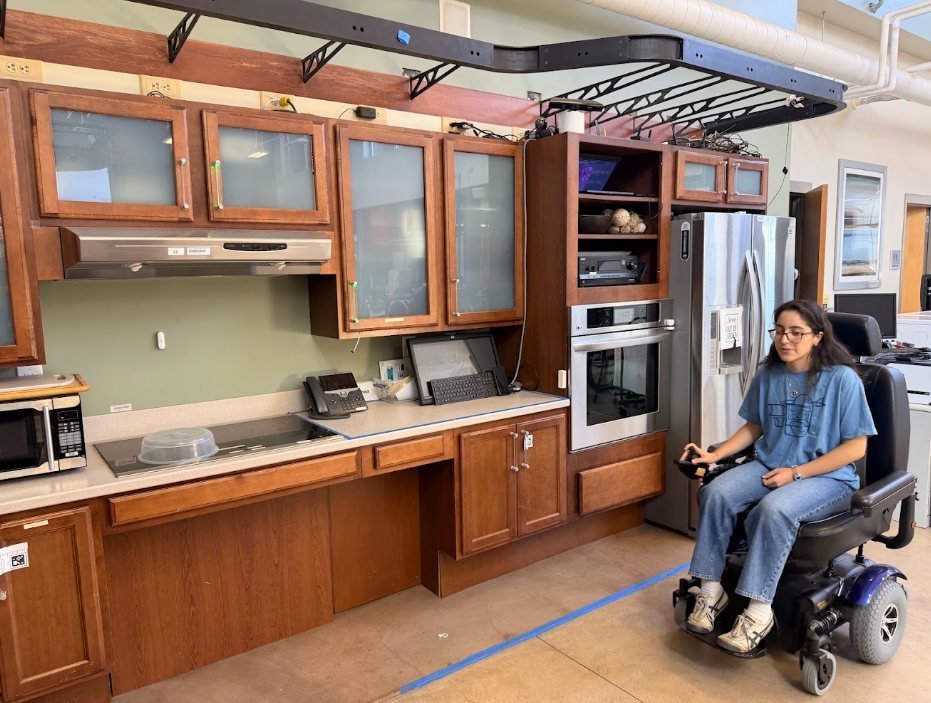
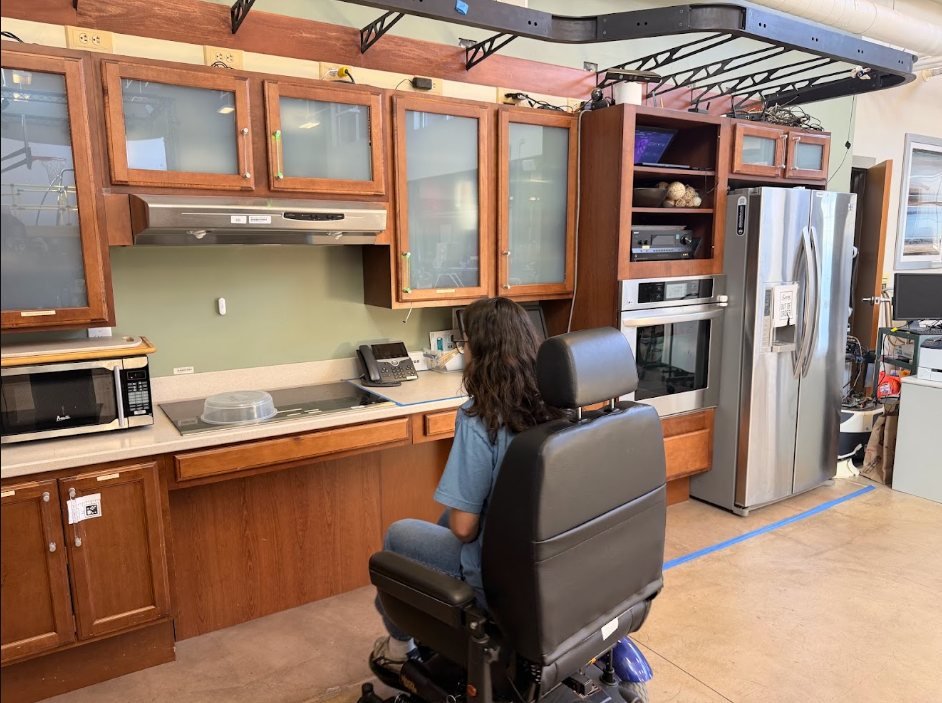
Standard power wheelchair going from refrigerator to stove.
Testing & Path Accuracy
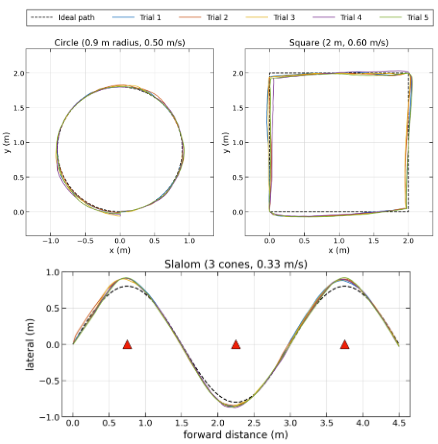
To measure how precisely the chair follows a commanded path, I drove three preset routes five times each and reconstructed the motion from the onboard sensors. Each path tests a different driving mode: the square tests straight-line accuracy and rotation, the circle tests sustained turning while facing the center, and the slalom tests lateral tracking around three cones. There was no significant path deviation between trials.
return error
radial error
cross-track error
5 trials each. Trial-to-trial spread about 0.5 cm on the square.
Why the Small Offset
The chair was repeatable but slightly biased in one direction, which pointed to fixed, correctable causes rather than random noise. The main suspects:
- Battery voltage differences between the three motor controllers, which make the wheels push unequally for the same command.
- Open-loop control: wheels are commanded by power rather than corrected against their measured speed, so small mismatches accumulate over the path.
- Direction- and speed-dependent wheel imbalance, so a single set of fixed corrections can't cover every case.
- Roller slip during sideways motion, where the wheels' passive side rollers grip less than rolling straight forward.
Where It's Going
The next steps come straight from the testing: closed-loop motor control to correct the wheels against their measured speed, a LiDAR sensor for obstacle detection and safety, and driving evaluations with Veteran wheelchair users in real lab settings.
For me, it's exactly the kind of engineering I care about: building technology that makes everyday life more independent for the people who use it.
Developed at the Human Engineering Research Laboratories with Dr. Jorge Candiotti and Dr. Rory Cooper. Supported by the Wheelchair and Rehabilitation Engineering (WaRE) Center grant and a Career Development Award Level 2 (CDA-2).